My Cockapoo Growls Over His Toys: Resource Guarding in Doodles
 Victoria Cooper

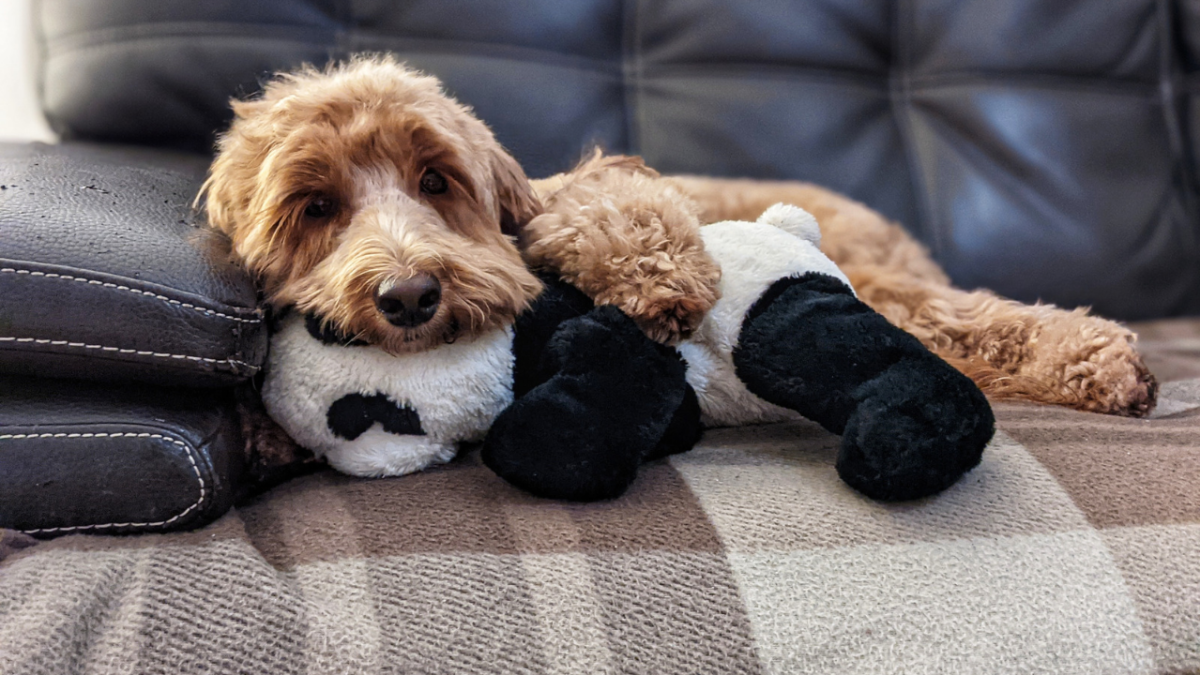
Your Cockapoo growls over a sock, a bone or the sofa. Here's why Doodles guard, why taking it off them makes it worse, and what to do instead.
It usually starts small.
A sock goes missing, turns up under the dining table with your dog curled around it, and when you reach for it there's a low noise you haven't heard before. Or you walk past the bowl at dinner time and notice they've gone still. Or they take a chew into another room and won't bring it back.
And somewhere in your head a voice says: that's the start of something.
It might be. But it's almost certainly not what you're afraid of, and what you do in the next few weeks matters far more than what your dog just did.
What resource guarding actually is
Resource guarding is a dog protecting something they value from being taken away.
That's it. It isn't dominance. It isn't your dog deciding they're in charge. It's a dog who has something good and is worried about losing it, which, when you think about it, is a completely reasonable thing for an animal to worry about.
Research following UK dogs found resource guarding to be the most commonly reported form of aggression, affecting around one in eight dogs. It is not unusual, and having a dog who does it does not mean you've got a dangerous animal or done something wrong.
Why Doodles in particular
There's a breed-specific reason this shows up so often in Cockapoos and Doodles, and it's rarely mentioned.
Both sides of the cross are retrieving and carrying breeds. Spaniels find things and bring them. Poodles were bred as water retrievers. Carrying objects in the mouth isn't a quirk in these dogs, it's hardwired.
So your Doodle picks things up constantly. Socks, tissues, the children's toys, something unidentifiable from the garden. Far more objects pass through their mouth in a week than would with many other breeds.
Which means far more opportunities for someone to take something off them.
And every single time that happens, your dog learns the same lesson: having something good means a human comes and removes it.
Do that often enough and a perfectly normal carrying instinct turns into a dog who hides behind the sofa with a crisp packet.
The advice that makes it worse
Here is what people are commonly told, and why each piece is wrong.
"Take it off them anyway, so they know you can." This confirms exactly what your dog was worried about. You've just proved that their concern was justified. Next time they'll start guarding earlier and more intensely, because waiting didn't work.
"Put your hand in their food bowl." Same problem. You're repeatedly threatening a resource in order to prove it isn't threatened. Dogs who tolerate this usually aren't relaxed about it, they've just learned that objecting doesn't help.
"Tell them off for growling." This is the most dangerous advice of the lot. A growl is a warning. It's your dog communicating, at considerable effort, before doing anything else. Punish the growl and you don't remove the feeling — you remove the warning. You end up with a dog who goes straight from still to snapping, with nothing in between.
What to do instead
The whole approach rests on one principle: your dog needs to learn that a human approaching means something good arrives, not that something good disappears.
Stop taking things off them. Not forever, for now. Every confiscation sets you back. If they've got a sock, let them have the sock unless it's genuinely dangerous. Most stolen items are far less urgent than they feel in the moment.
Dog-proof the house instead. Bins with lids. Washing out of reach. Children's toys put away. You cannot train a behaviour that is being rehearsed every day, so stop the rehearsals first.
Trade, don't take. When you do need something, swap it for something better. Approach, drop a piece of cheese a short distance away, and let them choose to leave the item. You're not negotiating with a terrorist, you're teaching your dog that giving things up is profitable.
Teach a cue for it. Once swapping works reliably, you can attach a word to it. But build the association first and name it afterwards, not the other way round.
Walk past the bowl and drop something good in. If guarding happens around food, this reverses the association entirely. You approaching becomes the best part of dinner rather than the threat.
Manage the environment. Feed in a separate room if there are other dogs or children. Give high-value chews in a quiet space where nobody will walk past. Removing the trigger is not cheating.
When to get help
Please speak to a qualified, force-free behaviourist if:
- Your dog has snapped, air-snapped or bitten
- There are children in the house
- The guarding is escalating, or appearing in new situations
- They're guarding people or places rather than objects
- It's appeared suddenly in a dog who never did it before
That last one matters more than people realise. A sudden change in behaviour, particularly around handling or being approached, can have a physical cause. A dog in pain guards more, because they have more to lose and less capacity to cope. It's always worth a vet check before assuming the problem is behavioural.
The thing to hold onto
Resource guarding responds well to the right approach. It's one of the more predictable behaviours to work with, because the underlying worry is so straightforward.
Your dog isn't challenging you. They're telling you they're frightened of losing something that matters to them.
Once you start answering that worry instead of overruling it, most of this resolves far faster than owners expect.
Victoria Cooper is a Certified Canine Behaviourist specialising in Cockapoos and Doodles. Resource guarding is the focus of December's sessions inside The Doodle Dog Academy, with clinical animal behaviourist Danielle Beck. [Find out more.]